Insights Shaping the Industry
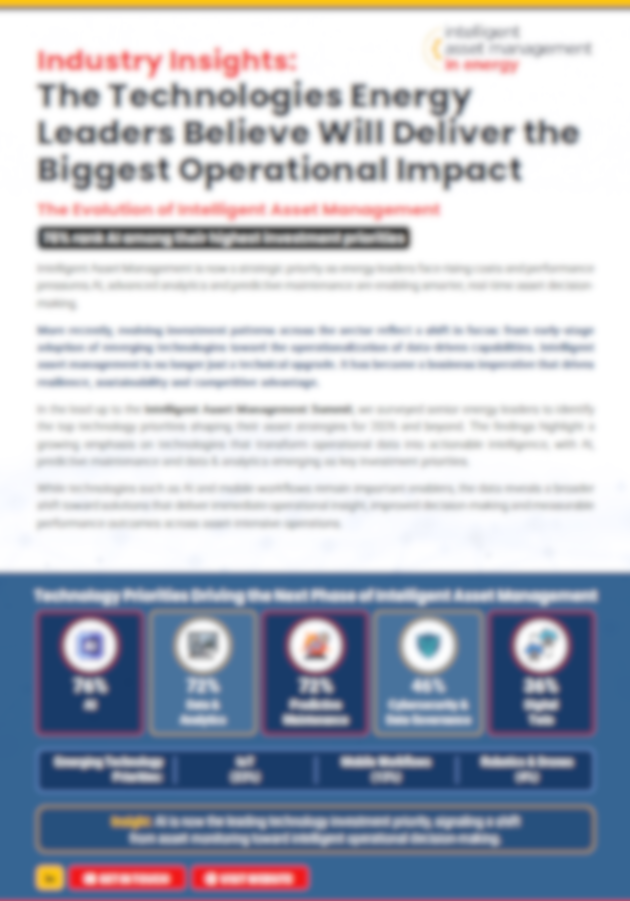
The Technologies Energy Leaders Are Prioritizing in 2026-2027
76% of energy leaders rank AI among their highest technology investment priorities. Based on exclusive survey insights from senior industry leaders, this infographic reveals the technologies expected to deliver the greatest operational impact across asset-intensive operations. Explore how investment priorities are shifting toward AI, predictive maintenance and advanced analytics to drive smarter decision-making and improved asset performance.
Download the infographic to discover:
- Why AI has become the industry's leading technology investment priority
- How predictive maintenance and analytics are reshaping asset management strategies
- Which technologies energy leaders expect to deliver the greatest operational impact
- How investment priorities are evolving across intelligent asset management programs
- Where emerging technologies such as digital twins, IoT and robotics fit into future plans
How Dow Cut Maintenance Costs by $4M Without Increasing Risk
What if the best reliability strategy isn't doing more maintenance, but doing less of the right kind?
In this exclusive interview, Amber Randon, Director of Reliability at Dow, explains how a risk-based reliability approach helped reduce maintenance costs by $4 million while maintaining acceptable risk levels. Learn how Dow is connecting reliability decisions directly to business value, prioritizing resources based on risk and reshaping the conversation around maintenance investment.
Download the interview to discover:
- The key principles behind Dow's risk-based reliability strategy
- How to balance reliability, risk and profitability across a complex asset portfolio
- How reliability leaders can build business cases that win executive support
- How Dow identifies maintenance activities that add cost without reducing risk
- Why reliability decisions should be treated as investment decisions, not maintenance decisions
- The role AI could play in supporting future reliability and maintenance strategies
bp’s Next Era of Intelligent Asset Management
As energy companies face mounting pressure to improve reliability, reduce costs and prepare for an AI-enabled future, bp is focusing on the fundamentals. In this exclusive interview, Natalie Thompson, Vice President of Reliability and Maintenance at bp, shares how her team is eliminating chronic failures, empowering frontline teams and building the foundations for long-term asset performance.
Download this interview to discover:
- How bp is eliminating chronic failures that drain maintenance budgets
- How frontline teams are moving from firefighting to continuous improvement
- How agentic AI, digital twins and global engineering talent are accelerating reliability performance
How Dow is Building an AI-Ready Workforce for the Next Era of Asset Management
"You can't modernize the workforce until you modernize the work itself."
As AI transforms asset-intensive industries, workforce readiness has become a critical business priority. In this exclusive interview, Lisa Williams, Senior Director of Operations Talent Strategy and Employee Experience at Dow, shares how the company is using skills intelligence, workforce planning and digital innovation to prepare employees for the future of work.
Download the interview to discover:
- How Dow is leveraging workforce planning to strengthen operational agility
- Why Dow believes nearly every role will evolve over the next 12-18 months
- How skills intelligence is helping identify capability gaps and future workforce needs
- Why frontline workers need stronger data literacy to work alongside AI-enabled tools
- How Dow is driving technology adoption by focusing on usability, trust and business value
- Practical lessons for building a workforce that can adapt to rapid technological change

How Noble Corporation Manages Asset Integrity Across 30 Offshore Vessels Operating 24/7
"In safety-critical environments, trust matters more than speed."
Operating 30 offshore drilling vessels around the clock, Noble Corporation must make asset decisions where safety, uptime and risk management are critical. In this exclusive interview, Jason Power shares how the company is improving decision-making through data quality, risk-based digitization and predictive analytics while building trust in AI across offshore operations.
- How Noble simplified complex systems to improve adoption and data quality offshore
- How Noble ensures data quality across offshore assets to support predictive analytics and AI
- Why Noble digitizes safety-critical systems first and uses risk to prioritize investment
- How simplifying technology increases adoption across offshore crews
- How Noble measures success through risk reduction and asset integrity, not tool deployment

AI, Data and Strategy: SoCalGas’ Journey to Smarter Asset Management
Operating more than 100,000 miles of pipeline, SoCalGas is using data, analytics and machine learning to make smarter asset investment decisions. In this exclusive case study, company leaders share how they are moving from reactive maintenance to risk-based planning while preparing the foundation for AI at scale.
Download the report to discover how SoCalGas:
- Prioritizes pipeline replacement using quantitative risk modeling
- Uses machine learning to make more objective capital investment decisions
- Builds trusted asset data foundations for predictive analytics and AI
- Overcomes data quality and integration challenges across legacy systems
- Creates organizational buy-in for data-driven decision making
In Partnership With:

QUESTIONS?
Telephone: +1 813-658-2511
Email: enquire@iqpc.co.uk

©2026 IQPC. All rights reserved.


