From Strategy to Execution: Connecting APAC to Advance Safe, Efficient and Sustainable Offshore DecommissioningMarch 18 - 19, 2027 l Novotel Perth Langley, Australia
Media Centre
Featured Content
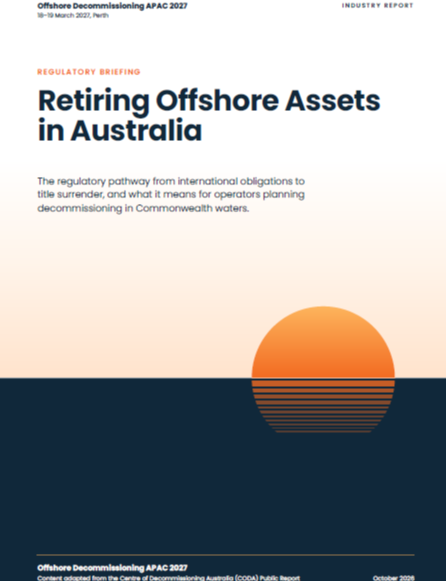
Retiring Offshore Assets in Australia
Your free guide to the rules of offshore decommissioning in Commonwealth waters, from international obligations to title surrender.
Australia's decommissioning activity is accelerating, but the rules were written for exploration and production. This 20-page briefing, adapted from CODA's national regulatory mapping study, shows you which laws apply, which approvals you need, and how long they take.
Inside you'll find:
- The four layers of regulation and where the 3 nm line matters
- The three documents NOPSEMA must accept before work starts
- What it takes to leave infrastructure in place
- Title surrender, trailing liability and a permit timeline
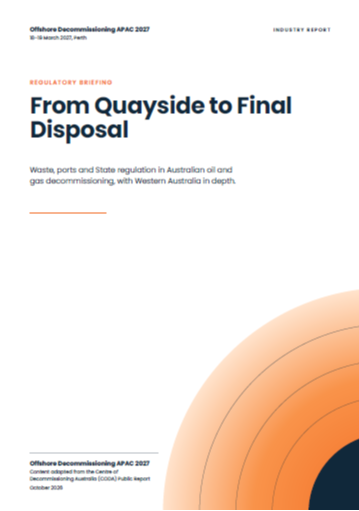
From Quayside to Final Disposal
From Quayside to Final Disposal: Waste, Ports and State Regulation in Australian Oil and Gas Decommissioning
Understand the regulatory requirements, approval timelines and waste management challenges that shape offshore decommissioning in Australia, with a focused look at Western Australia.
What happens when decommissioned offshore infrastructure reaches shore? From hazardous waste classification and port permits to interstate transport and final disposal, every stage introduces new regulatory requirements that can affect project timelines, costs and execution.
This free industry report, adapted from the Centre of Decommissioning Australia (CODA)'s public regulatory mapping study, provides a focused briefing on the onshore regulations governing oil and gas decommissioning across Australia.
What You'll Discover
Navigate Australia's regulatory landscape: Understand the key Commonwealth, State and Territory requirements governing waste, transport, recycling and disposal.
Plan for Western Australia's approval timelines: Explore key permits, licensing requirements and lead times, including approvals that may need to be initiated 12 months or more before decommissioning begins.
Identify hazardous materials and disposal pathways: Learn how NORM, mercury, asbestos, PFAS and other materials can affect handling, transport and disposal options.
Understand port and logistics requirements: Review the permits and regulatory considerations involved in moving decommissioned structures and hazardous waste through Australian ports.
Compare waste destinations and transport requirements: Explore the regulatory considerations for interstate waste movements, overseas exports and Australia's hazardous waste disposal facilities.
Build a more effective decommissioning roadmap: Identify practical steps for planning waste strategies, coordinating regulators and accounting for long approval lead times.
Who Should Download This Report?
This report is designed for offshore operators and asset owners, decommissioning contractors, ports and fabrication yards, recyclers and waste processors, marine and heavy-lift providers, logistics companies, and regulatory stakeholders involved in Australia's oil and gas decommissioning sector.
Get Your Free Copy
Prepare for the onshore regulatory challenges of offshore decommissioning. Download the report to understand the requirements from quayside to final disposal and support more informed project planning.
Adapted from Australia's Oil and Gas Decommissioning Regulatory Landscape, Public Report, Centre of Decommissioning Australia (CODA), April 2026. This report is for general information only and does not constitute legal advice.
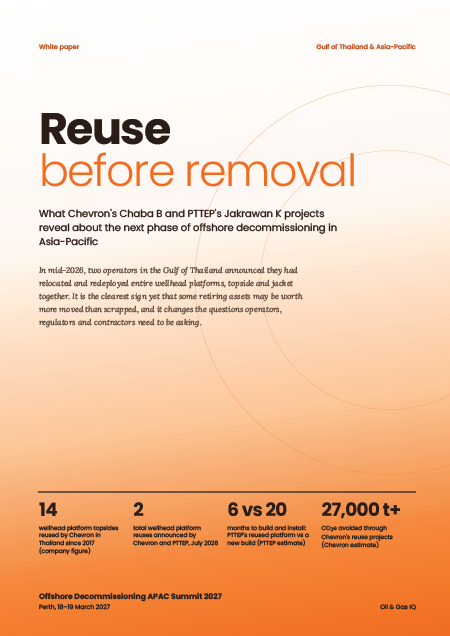
Reuse Before Removal Report
Reuse Before Removal: What the Gulf of Thailand reveals about the next phase of offshore decommissioning
In mid-2026, Chevron and PTTEP each relocated and redeployed an entire wellhead platform in the Gulf of Thailand. This free white paper explains what it means for decommissioning across Asia-Pacific.
Inside, you'll find:
- What happened at Chevron's Chaba B and PTTEP's Jakrawan K, and how both projects built on nearly a decade of topside reuse
- The three types of "reuse" (topside reuse, total reuse and reefing) and why the difference matters for pricing, permitting and bidding
- Why the business case is about speed and cost, not only carbon, including PTTEP's estimate of 6 months to install versus about 20 for a new build
- Where reuse works best, and why nearby demand for the asset matters
- Why removal still isn't going away, with lessons from the Erawan field handover
- What reuse asks of the supply chain, from structural assessment to heavy lift and regulatory approvals
- What Australia and wider APAC can learn, including Australia's A$43.6 billion decommissioning liability estimate
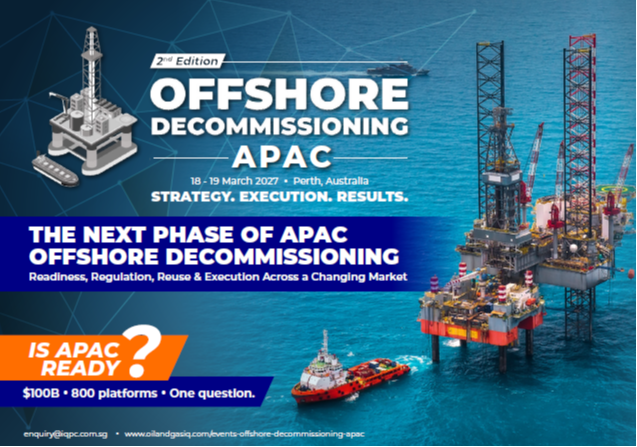
The Next Phase of APAC Offshore Decommissioning Report
The Conversation Has Moved from "When?" to "How?"
Ageing offshore platforms across Australia, Malaysia, Thailand, Indonesia and beyond are moving from production into retirement. Northern Endeavour's Phase 3A tender is out. PETRONAS is running its largest coordinated retirement program to date, covering 31 platforms. Operators are looking beyond removal toward reuse, reefing and recycling. But vessels are scarce, specialist skills are thin, and recycling capacity is lagging behind. This report looks at whether the region is ready, and what needs to happen next.
What You'll Learn:
- The scale of the challenge. A market-by-market view of ageing platforms across Indonesia, Malaysia, Thailand, Brunei and Australia. It also explains why Australia carries the biggest liability despite having fewer assets.
- Three regulators, one region. How NOPSEMA, MPM/PETRONAS and the UK's NSTA approach compliance. It also makes the case for replacing Australia's three separate approvals with a single integrated plan.
- Design it, don't retrofit it. ADNOC's lifecycle approach to well integrity, which builds P&A into well design from day one.
- From removal to reuse. Case studies from PETRONAS, PTTEP and Chevron Thailand. One is a platform reuse that cut execution time from around 20 months to 6 and construction costs by 35–50%.
- What APAC can learn. Benchmarks from Norway, the UK and Brazil on regulation, cost discipline and deepwater scale.
- The supply chain question. Where vessels, workforce and waste capacity fall short, and why visibility is the missing layer.
- Five priorities for what comes next. A practical agenda for operators, regulators and the supply chain.
"Essentially, we needed everything. We needed the skills, the knowledge, the experience, the technologies, and the vessels." - Dr Francis Norman, CEO & Managing Director, CODA
Get Your Free Copy Now!

Global Offshore Decommissioning Projects List
Global Offshore Decommissioning Projects Report
Gain intelligence on major offshore decommissioning programmes worldwide—from the North Sea to Brazil and Australia.
Download the full report to explore case studies, project updates, and the $100B+ opportunity shaping the future of offshore energy.

Artificial Intelligence Machine Learning Compliance
This session explores how AI and machine learning are being applied across offshore and maritime operations, and how compliance, governance, and risk management are evolving alongside these technologies.
Key takeaways include:
- Use of AI for predictive maintenance, anomaly detection, and navigation optimisation
- Importance of data quality, transparency, and human oversight in ML systems
- Emerging regulatory landscape including ISO standards and regional AI frameworks
- Critical role of risk management and validation in ensuring safe deployment
As digitalisation accelerates across offshore operations, these insights highlight where technology providers can add real value.

Oil, Energy and Marine Tech Navigator
Welcome to the Marine Tech Navigator, your essential guide to navigating the top vendors and solution providers in the offshore marine industry. As the industry advances with complex challenges and demands for efficiency, selecting the right partners and technologies has never been more critical. This guidebook offers a curated overview of the most innovative and reliable providers in key categories, from vessel maintenance and safety equipment to digital transformation solutions and environmental compliance services. With insights drawn from industry experts and leaders, this resource serves as a trusted reference for offshore professionals, whether you’re streamlining operations, enhancing safety, or exploring sustainability initiatives. By spotlighting the best-in-class vendors and cutting-edge solutions, the tech navigator empowers you to make informed decisions that support your operational goals and advance industry standards. Dive in to discover the solutions driving the future of offshore excellence
Sponsorship & Exhibition Information

Offshore Decommissioning APAC Summit Agenda Brochure (Solution Providers)
Download the Offshore Decommissioning APAC Summit 2027 Agenda Brochure
Explore the full agenda for the Offshore Decommissioning APAC Summit 2027, taking place on 18–19 March 2027 in Perth, Australia. Discover the latest strategies, technologies, and operational approaches shaping the region's US$100 billion decommissioning market—from Plug & Abandonment execution, regulatory compliance, and heavy-lift removals to late-life asset repurposing, digital twins, and supply chain readiness.
Download the brochure to see the complete programme, distinguished speaker lineup, live operator case studies, and details on our full-day executive masterclass.
Offshore Decommissioning APAC Summit 2027 Sponsorship Prospectus
Position Your Brand at the Forefront of APAC's Offshore Decommissioning Market
Asia-Pacific is entering a major wave of offshore asset retirement, creating significant opportunities for companies providing engineering, technology, marine, well P&A, environmental and decommissioning solutions. The Offshore Decommissioning APAC Summit 2027, taking place 18–19 March 2027 in Perth, brings together senior decision-makers from operators, EPCs, regulators and specialist service providers who are actively planning and executing decommissioning programmes across the region.
Discover how your organisation can get in front of the decision-makers shaping APAC's next generation of offshore decommissioning projects. Download the Sponsorship Prospectus to explore available partnership opportunities, showcase your expertise, generate qualified leads and position your brand alongside the region's leading offshore operators and contractors.
Limited partnership opportunities are available across thought leadership, exhibition, content marketing and bespoke engagement packages.
From Quayside to Final Disposal (Solution Provider)
From Quayside to Final Disposal: Waste, Ports and State Regulation in Australian Oil and Gas Decommissioning
Understand the regulatory requirements, approval timelines and waste management challenges that shape offshore decommissioning in Australia, with a focused look at Western Australia.
What happens when decommissioned offshore infrastructure reaches shore? From hazardous waste classification and port permits to interstate transport and final disposal, every stage introduces new regulatory requirements that can affect project timelines, costs and execution.
This free industry report, adapted from the Centre of Decommissioning Australia (CODA)'s public regulatory mapping study, provides a focused briefing on the onshore regulations governing oil and gas decommissioning across Australia.
What You'll Discover
Navigate Australia's regulatory landscape: Understand the key Commonwealth, State and Territory requirements governing waste, transport, recycling and disposal.
Plan for Western Australia's approval timelines: Explore key permits, licensing requirements and lead times, including approvals that may need to be initiated 12 months or more before decommissioning begins.
Identify hazardous materials and disposal pathways: Learn how NORM, mercury, asbestos, PFAS and other materials can affect handling, transport and disposal options.
Understand port and logistics requirements: Review the permits and regulatory considerations involved in moving decommissioned structures and hazardous waste through Australian ports.
Compare waste destinations and transport requirements: Explore the regulatory considerations for interstate waste movements, overseas exports and Australia's hazardous waste disposal facilities.
Build a more effective decommissioning roadmap: Identify practical steps for planning waste strategies, coordinating regulators and accounting for long approval lead times.
Who Should Download This Report?
This report is designed for offshore operators and asset owners, decommissioning contractors, ports and fabrication yards, recyclers and waste processors, marine and heavy-lift providers, logistics companies, and regulatory stakeholders involved in Australia's oil and gas decommissioning sector.
Get Your Free Copy
Prepare for the onshore regulatory challenges of offshore decommissioning. Download the report to understand the requirements from quayside to final disposal and support more informed project planning.
Adapted from Australia's Oil and Gas Decommissioning Regulatory Landscape, Public Report, Centre of Decommissioning Australia (CODA), April 2026. This report is for general information only and does not constitute legal advice.
In Partnership With:

QUESTIONS?
Contact us via email at enquiry@iqpc.com.sg.

©2026 IQPC. All rights reserved.