The Fragility Trap: The Hidden Cost of Automating Understanding
Discover how automation can improve efficiency while quietly eroding the human judgment needed when operations move beyond the script
Add bookmark

Industrial automation has often made plants more consistent and efficient, and, in many settings safer. But beneath these gains lies a quieter risk: as software absorbs routine interpretation, human judgment can decay in ways that remain invisible until the system is under stress.
A plant's true capability is never revealed on a calm weekday morning. It is revealed when conditions depart from the script and people must bridge the gap between what the system expected and what the situation requires. In those critical moments, resilience depends not on automation alone, but on the human capacity to interpret ambiguity, synthesize incomplete information, and make sound judgments under uncertainty.
The fragility trap is a paradox. In the pursuit of routine reliability, organizations systematically degrade the human capacity to manage the abnormalities. Ironically, this forces reliance on the very capabilities they have worked to marginalize and left to atrophy.
Digital Taylorism: The Automation of Interpretation
The most dangerous consequence of automation may not be that humans stop doing the work. It may be that they stop understanding it.
A century ago, Frederick Taylor's scientific management separated the planning of work from its execution. Managers determined how work should be done , and workers carried out the prescribed tasks.
Digital Taylorism extends that same logic into cognitive work. Instead of automating only physical effort, digital systems increasingly automate interpretation itself. Automated systems determine what information matters, what it means, and which actions should follow. The result is a subtle but profound shift in that people remain responsible for execution while understanding increasingly resides within the system. As long as reality conforms to the system's assumptions, deep understanding becomes less necessary.
Two Forms of Automation
To manage this risk, leaders must distinguish between two fundamental types of automation:
- Automating effort: Removing physical, repetitive, or routine tasks to improve efficiency
- Automating interpretation: Reducing the human need to interpret conditions, diagnose problems, and make sense of what is happening
When digital systems determine what information matters and which response should follow, operators gradually become executors of system output rather than interpreters of the process. Compliance begins to replace comprehension.
This is not an argument against standardization. Standardization remains one of the most effective tools for improving safety, quality and consistency.
The danger emerges when organizations optimize exclusively for predictable performance and unintentionally erode the understanding, experience, and judgment required when conditions move beyond the assumptions built into the system. Automation can reduce routine effort, but when it removes repeated exposure to ambiguity and degraded modes, it can erode the interpretive capability needed under stress.
Digital Taylorism rarely arrives as a deliberate decision to eliminate human judgment. It emerges through a series of reasonable decisions to make judgment less necessary:
- Standardize the process
- Automate the routine
- Create a dashboard
- Add alerts
- Reduce variation
- Measure compliance
- Centralize expertise
Each decision may improve a specific task. Aggregated over time, however, they can produce a dangerous asymmetry: Routine performance remains stable while human interpretive capability quietly declines. The organization appears increasingly reliable until reality moves beyond the assumptions embedded in the system.
The 4 Traps of Digital Taylorism
Digital Taylorism erodes interpretive capability through 4 reinforcing traps. Fragmentation and Standardization reshape the work itself; Passive Monitoring and Situational Atrophy reshape how people relate to it. Together, they form a sequence in which routine performance improves while resilience weakens.
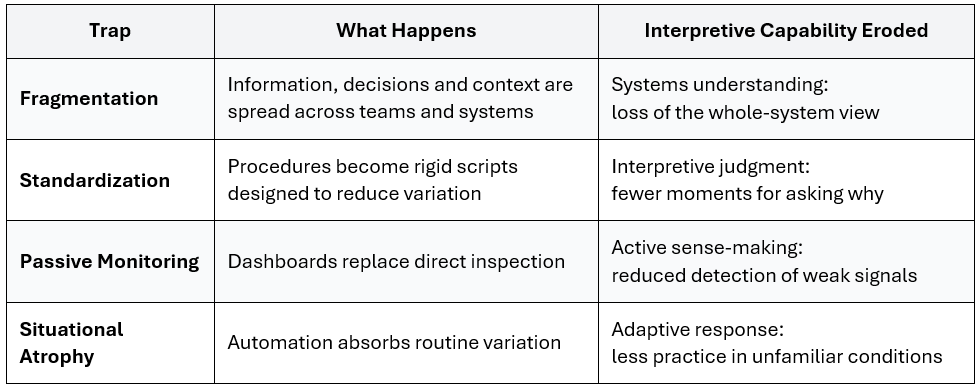 Table 1. The 4 Traps of Digital Taylorism
These traps are not independent. They reinforce one another. Fragmentation weakens the whole-system view. Standardization shifts attention from interpretation to compliance. Passive monitoring replaces direct observation with system notification. Situational atrophy then reduces the experience needed when the system's assumptions fail. Together, they create a system that can continue performing normally while the human capacity to understand its failure quietly deteriorates.
How Fragility Quietly Accumulates
In the pursuit of reliability, scale and cost reduction, organizations turn to automation to eliminate process variability.
They do not seek to eliminate expertise.
They seek to eliminate their dependence on it.
Human judgment is often treated as a source of inconsistency, a constraint on standardization, scale and predictable performance. The goal becomes to build systems that perform reliably regardless of who is operating them.
Digital Taylorism is rarely deliberate. It emerges from the pursuit of operational excellence. The mistake is assuming that human expertise can be fully captured in code. Organizations translate a skilled person's decisions, workflows and experience into a digital system and assume the expertise itself has been preserved. But expertise is more than a sequence of steps. It includes tacit judgment: pattern recognition, weak-signal detection and the ability to sense that something is wrong before the data is conclusive.
As expertise becomes encoded, organizations rely less on the people who possess it. Expertise is not eliminated; it is practiced less. That is the deeper loss. Automation does not simply remove people from tasks. It removes them from the living center of the work. They encounter fewer abnormalities, fewer unscripted conditions and fewer opportunities to develop the intuition required to recognize when the script breaks. The next generation learns the procedure, but not always the system.
Over time, routine performance becomes more stable while human interpretive capability declines. The organization becomes increasingly capable of executing what is known and increasingly vulnerable when reality moves beyond the model. The system preserves the procedure. It does not necessarily preserve the capability
The goal, then, is not automation that makes people less necessary. The goal is healthy automation: automation that removes drudgery without removing judgment, that expands human capability instead of hollowing it out, and that keeps operators close enough to the process to understand it when conditions change. Good automation should bridge the gap it creates by preserving the human capacity to interpret, challenge and recover when the system reaches its limits.
That is the real test of automation. Not whether it can execute the routine, but whether it leaves people capable when the routine ends.
Evidence: When Interpretation Fails
The consequences of the erosion of interpretation are not theoretical. They become visible when systems encounter conditions beyond their operating assumptions. In such moments, the question is no longer whether technology can perform as designed, but whether the humans operating within the system can still interpret what is happening when information is incomplete, contradictory or misleading. The following cases reveal the effects of Digital Taylorism when interpretive capability has gradually eroded.
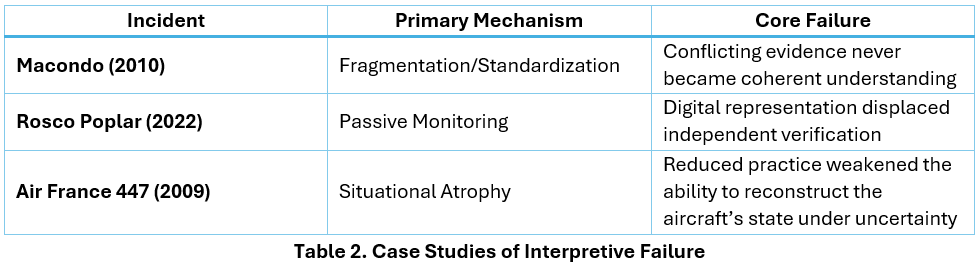
Macondo (2010): When Data Fails to Become Understanding
The data were present, but the pieces never formed a whole.
During the final negative-pressure test aboard the Deepwater Horizon, instruments produced conflicting readings. The signals did not point to a single explanation for the well's condition. Rather than resolving the contradiction, the crew explained the anomalous readings through familiar interpretations, including sensor error, the "bladder effect," and trapped pressure.
The failure was not a lack of information. It was the inability to integrate conflicting evidence into a coherent understanding of the well's state. The system was producing data, but the data was never understood. Eventually, completing the procedure became a substitute for understanding.
Rosco Poplar (2022): When the Screen Becomes the Authority
The bulk carrier Rosco Poplar was navigating the Great Barrier Reef using electronic navigation systems. A GPS unit, affected by an antenna malfunction, began transmitting incorrect position data, which then spread across the vessel's navigation displays. The bridge team accepted the electronic position without independently verifying it against visual observation or other available navigational references.
The problem was not simply that the digital system displayed an incorrect position. The deeper failure was that the digital picture displaced the habit of verifying the system against reality. The digital representation had replaced the reality it was supposed to track.
Air France 447 (2009): When Automation Returns the Problem
The aircraft's automation handled much of the interpretation required during normal operations. When it disengaged, the pilots were suddenly required to reconstruct the aircraft's state themselves. Unreliable airspeed data caused the autopilot to disengage, leaving the pilots to determine the aircraft's state from incomplete, rapidly changing and conflicting information. The challenge shifted from following a procedure to interpreting an unfolding situation in real time.
The Central Danger
Together, these cases reveal the central danger of Digital Taylorism. Technology does not need to fail completely to create vulnerability. It only needs to encounter conditions beyond its operating assumptions. At that moment, the responsibility returns to humans. The question is whether those humans still possess the practiced capability to understand what is happening.
In each case, the system's normal operating logic became insufficient when reality moved beyond its assumptions. The failure was not merely technological; it exposed the consequences of allowing the human interpretive capability required for recovery to weaken. The capability that routine systems had gradually displaced became the capability failure demanded most.
Diagnosing the 4 Traps of Digital Taylorism
The 4 traps of Digital Taylorism are not merely operational. They are cognitive. Together, they create a gradual transfer of understanding from people to systems. The organization may become more efficient, but the people within it may become progressively less capable of understanding, challenging and recovering when those systems fail.
The table below shows the cognitive pathway to fragility as automation gradually displaces critical human capabilities. The diagnostic questions help leaders determine whether the organization is still preserving the questions essential to resilience.
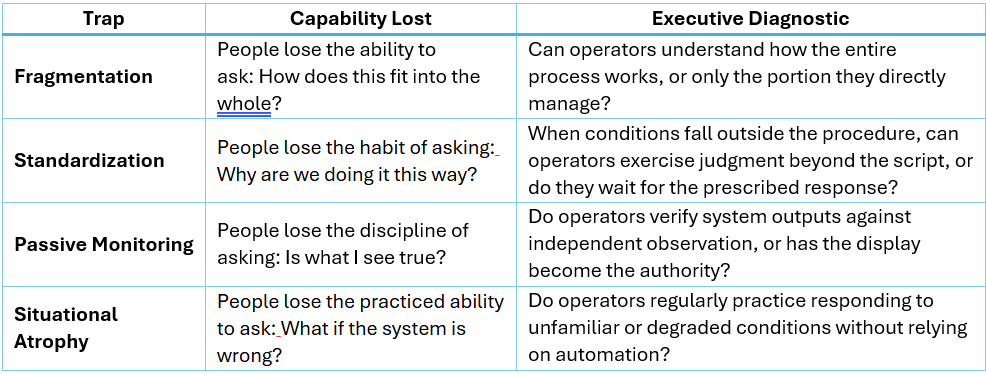
Table 3. Digital Taylorism Diagnostic
Automation should reduce routine effort, not routine understanding. If these questions expose uncertainty, the issue is not technology itself. It is whether the interpretive capabilities needed when the system reaches its limits are still being deliberately preserved.
The future of automation should be measured not only by how much human judgment it can eliminate, but by how much human capability it preserves for the moment the system is wrong.
What Comes Next
Beneath the 4 traps lies the Learning Vacuum. Automation absorbs not only the work, but also the experience from which expertise is built. The next article explores the challenge ahead: how do we design human–machine relationships in which people understand not only what systems do, but how they work, why they act, and when human judgement must re-enter the system?
The future of automation should not be measured only by what machines can do for humans, but by whether humans continue to develop through their relationship with machines. The goal is not simply to keep humans in the loop, but to ensure the loop remains developmental, so people continue to learn, adapt and grow alongside increasingly capable systems rather than gradually losing the understanding and capability required to guide them.
Editor's Note
Digital Taylorism1 extends scientific management into the digital age by shifting interpretive work from people into digital systems. As judgment migrates into these systems, people become increasingly efficient at following the process and increasingly less practiced at operating without it.
Bibliography
Case Studies: Australian Transport Safety Bureau. Near Grounding of Rosco Poplar, off Bond Reef, Hydrographers Passage, Queensland, on 4 May 2022. ATSB Transport Safety Report No. MO-2022-005. July 2024.
Bureau d'Enquêtes et d'Analyses pour la Sécurité de l'Aviation Civile (BEA). Final Report on the Accident on 1 June 2009 to the Airbus A330-203 Registered F-GZCP Operated by Air France Flight AF 447. July 2012.
National Commission on the BP Deepwater Horizon Oil Spill and Offshore Drilling. Deep Water: The Gulf Oil Disaster and the Future of Offshore Drilling - Report to the President. January 2011.