Advancing Oil and Gas Operations with Drone Technology
Learn how oil and gas operators can use drones to reduce risk, enhance inspections and build a reliable, scalable aerial operations program
Add bookmark
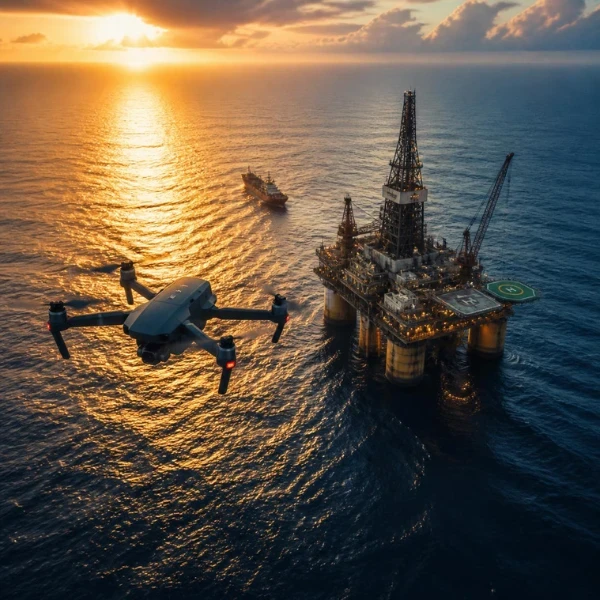
Drones in oil and gas have moved well beyond experimental trials and promotional aerial footage. In mature deployments, they operate as an internal service that feeds inspections, integrity decisions and field response.
This article focuses on what operators can implement today, and just as importantly, what can limit success. Outlining where drones reliably reduce exposure and shorten detection-to-response cycles and where safety cases, governance, data handling, automation and operational constraints determine whether a program delivers value or quietly stalls.
Core Use Cases
Below are the core use cases where drones move beyond experimentation to deliver repeatable operational value.
Asset Patrol and Visual Inspection
Visual patrols of aboveground pipelines, supports, flare tips, and other elevated structures to detect physical damage, missing covers, third-party encroachment, and surface indicators associated with leaks. Drones are used for targeted inspections of areas that are difficult or hazardous for routine human access, to improve situational awareness, and to support condition tracking through repeatable flights.
Visual patrols of above‑ground pipelines, supports, flare tips and other elevated structures to detect damage, missing covers, third‑party encroachment and leak indicators, particularly in areas that are difficult or hazardous to access. Standardized flight paths support condition tracking over time.
Thermal Anomaly Detection
Thermal surveys identify insulation degradation, steam releases, hot spots, abnormal temperature profiles and building heat loss. In utility corridors (e.g., powerlines and substations), thermal imaging can flag overheating connectors across elevated racks and long runs that are impractical to inspect from the ground.
Gas Leak Localization
Gas sensing to localize hydrocarbon and methane leaks using onboard sensing payloads or remote detection methods. Early deployments typically rely on point measurement sensors because they are easier to validate and operationalize in field conditions. Findings should trigger ground verification and structured work orders to confirm and classify leaks.
Construction And Turnaround Intelligence
Orthomosaics and site captures to quantify progress against the construction plan, identify deviations in staging and laydown areas, support placement planning for temporary structures and heavy equipment and document work fronts for coordination.
Environmental Surveillance
Monitoring to detect unauthorized dumping, inspect water lines and crossings for leaks or damage, and assess roads and fencing after storms. In some cases, drones support targeted vegetation control around restricted infrastructure, requiring strict chemical handling, drift control and clear separation from process zones.
READ: How to Build a Robust OT Cybersecurity Framework
Advantages Of Drones in Oil And Gas Operations
The use cases above illustrate where drones are applied. Their value, however, comes from a set of cross-cutting advantages that change how inspection, monitoring and coordination are performed.
Worker risk reduction
Drones shift inspection and monitoring away from direct human exposure to hazardous environments such as work at height, energized equipment, chemicals and rugged terrain.
Operational Reach
Unlike fixed cameras or ground patrols, drones provide flexible access to elevated, linear and spatially distributed assets, enabling coverage where permanent installations or direct human involvement are impractical.
Decision-ready Data and Faster Response Coordination
Georeferenced imagery, thermal evidence, orthomosaics and time‑stamped video create a shared visual ground truth across integrity, maintenance, HSE, environmental and project teams. This accelerates assessment, clarifying required skills/equipment and improving contractor coordination.
READ our latest, exclusive interview on: bp’s Next Era of Intelligent Asset Management
Consistency and Repeatability For Condition Tracking
Standardized flight paths enable reliable before-and-after comparisons, supporting condition trending and maintenance planning instead of isolated checks.
Establishing Drones as An Operational Capability
Organizations often start with a contractor, a limited fleet and a single use case. The real inflection point happens when the program shifts from “we just fly” to “we deliver value.” That usually requires four building blocks:
Operating Model
A drone service works best when it is treated like a shared internal capability with clear intake and prioritization, not a hobby for a single department. Mature programs use a structured request process that defines the asset, location, objective, urgency and required outputs, supported by a flight calendar to manage demand. Clear handoffs to asset integrity, maintenance, HSE, environmental or security teams ensure that findings drive action.
Skills And Expertise
Results improve when piloting is paired with asset knowledge. Teams perform better when operators understand equipment geometry, common failure modes and inspection priorities, often by training internal staff rather than relying solely on contractors.
Safety By Design
High‑reliability programs often use two‑person operations, with one operator flying and managing sensors, while a second maintains visual oversight and situational awareness, reducing risk in complex industrial environments.
Actionable Standardized Outputs
Value comes from decision-ready evidence rather than raw media. Effective programs standardize georeferenced imagery, thermal findings with inspection notes, orthomosaics for planning, and time-referenced video for review.
Automation, AI, and Drone Ports
Human-operated flights can deliver value, but they become difficult to scale across large asset portfolios due to operator availability and review workload. Autonomous infrastructure, often referred to as drone ports or drone-in-a-box systems, addresses the flight side of this constraint by enabling scheduled, repeatable inspections without on-site pilots. These systems automate takeoff, mission execution, landing, data transfer and battery charging or replacement, enabling consistent inspections across many assets.
As flight automation scales, data volume quickly becomes the next bottleneck. Long linear assets generate thousands of images per mission, making full manual review impractical. This is where AI-based analysis becomes a necessary complement to automation. Computer vision models can pre-screen imagery to highlight thermal anomalies, visible damage patterns, missing components, or foreign objects, reducing the volume of material requiring human attention.
In oil and gas, credibility depends on validation rather than model sophistication. Effective programs train AI models on data from their own environments, focus on narrowly defined defect types, and use AI strictly as decision support.
Humans remain responsible for final classification, engineering judgment, and work order creation. The operational gain is not replacing inspectors; it is compressing review time, so attention is focused on where it matters most.
Automation succeeds only when paired with reliable comms, weather gating, accurate 3D site models and robust cybersecurity. Because autonomous systems and AI pipelines touch operational networks and sensitive data, you need clear controls to mitigate malware, unauthorized access and data manipulation risks.
READ: SoCalGas’ Journey to Smarter Asset Management
Drone Operational Constraints
Weather, power systems, and radio conditions impose practical limits on drone operations. Cold temperatures, precipitation and wind directly affect endurance and data quality. While some platforms can operate at very low temperatures, cold reduces battery efficiency and shortens flight time. Precipitation is often the limiting factor because it degrades image quality, sensor performance and flight stability.
Battery performance and safety require careful management. Capacity loss in cold conditions is real but rarely extreme; the greater risk comes from reduced available power and increased internal resistance, which can cause voltage sag under load. Teams mitigate this through disciplined battery warming and storage, conservative flight planning with adequate reserves, and strict inspection and retirement criteria. In hazardous areas, battery integrity is critical, as thermal runaway or ignition is unacceptable.
Radio frequency interference is another constraint in industrial environments. Large metal structures can disrupt compass accuracy and communication links, requiring reconnaissance of new areas, conservative standoff distances and flight paths that prioritize link stability over maximum range.
Measuring Drone Operational Value
A credible assessment of drone operational value starts with understanding lifecycle cost. Mature programs track airframe flight hours, battery degradation under real-world site conditions, common failure modes such as prop damage, gimbal wear, link instability, or software faults and overall downtime driven by maintenance and spare-part availability.
Operational value is then measured against the avoided cost and the reduction in exposure. This includes labor hours saved from routine inspections, fewer equipment shutdowns, shorter anomaly detection-to-dispatch cycles, fewer personnel exposed to work at height or confined-space entry and faster environmental response when issues arise.
ROI should be presented through before-and-after comparisons on recurring tasks, such as flare inspection planning, pipeline patrol cycles, water sampling operations, or turnaround progress tracking. Programs that succeed focus on specific workflows and measurable deltas rather than generalized productivity claims.
Conclusion
In oil and gas, drones deliver the most value when they are treated as a controlled operational capability rather than a shortcut or a surveillance tool. They expand visibility, reduce exposure, and accelerate decision-making, but they do not eliminate the need for engineering judgment, ground verification, or disciplined safety processes.
The most successful programs are conservative by design. They position drones as a support mechanism for integrity, HSE, environmental, and project teams, not as an enforcement instrument. Findings are reviewed by qualified specialists before action and data handling follows the same disciplined governance applied to other operational information. Clear limits are set around where drones are used, under what conditions, and with what escalation paths.
If a drone program still revolves around a small group of pilots and occasional missions, the next step is not adding more aircraft. It is building the service layer around them: intake, scheduling, safety case, standardized outputs, automation and measurable outcomes. That discipline is what turns drones from a helpful tool into a reliable part of operations.